

Every printed kurta for women has a repeat pattern. The same motif is printed at equal distances and looks the same every single time across the whole fabric. A block print kurta also has a repeat.
But if you look carefully, each motif is slightly different from the last. A small change here, a deeper color press there. That small difference tells you everything. One came from a machine. The other came from a person in Rajasthan, sitting with a wooden block and a tray of natural dye.
This guide will help you understand both before you buy your next block print kurta or printed kurta.
What Are Block Print Kurtas?
1. What Is Block Printing?
Block printing is a very old craft in India. The Chippa community of Bagru village in Rajasthan started this work 400 years ago. Jaipur, Sanganer, and Barmer are still active centres of this craft today, with thousands of artisan families doing this work.
An artisan first carves a design into a wooden block. Teak and rosewood are the most commonly used woods. That block is dipped in dye and pressed firmly onto the fabric by hand. If a design has three colors, three separate blocks are used, one for each color, pressed one at a time in a specific order. Some designs need five or more blocks to complete. A single hand block print kurta can take a full day or more to finish. After printing, the fabric is dried in open sunlight before the colors are fixed.
Natural dyes used in traditional block printing come from plants and minerals. Indigo gives deep blue, madder root gives red, and turmeric gives yellow. Rajasthani artisans have been using these same dye sources for generations, and in some families, the dye recipes are kept within the household and passed down to children.
2. Why Are Block Print Kurtas So Popular?
Every piece of a genuine hand block print kurta is different from the next one. The motif repeat will have small variations in alignment. The dye will spread a little differently at the edges each time the block is pressed. These small differences are not mistakes. They are proof that a person made this piece, and people who understand craft know how to read that.
Block print kurta sets also carry a sustainable fashion value. No machines, natural dyes, and each piece takes hours of skilled work. For women who want ethnic Indian wear for women that carries some meaning beyond just a pretty pattern, block print kurtas are a strong choice.
What Are Printed Kurtas?
1. How Are Printed Kurtas Made?
Printed kurtas are made using machines. The three main methods are screen printing, digital printing, and rotary printing. In screen printing, a flat stencil is laid on the fabric and ink is pushed through it mechanically. In digital printing, a design file is sent to an industrial machine and printed directly onto the fabric, similar to how a printer works on paper. Rotary printing uses cylindrical rollers with the design engraved on them, and hundreds of metres of fabric can be printed in one hour.
2. Why Do People Buy Printed Kurtas?
Price is the clearest reason. A machine-printed kurta for women can be one-third the cost of a hand block print piece. For daily use, office, or college, that makes real practical sense.
The variety is also much wider. New seasonal prints, trendy designs, and fresh colour combinations come out fast with machine printing. For women who want the best kurtis for office wear in multiple colors, printed kurtas are a very practical option. The availability is high, and the turnaround from trend to product is fast.
Also read: Best Casual Co-Ord Sets for Women to Wear This Summer 2026
Block Print Kurtas vs. Printed Kurtas: Key Differences
Here are the key differences you need to know. Check carefully:
|
Feature |
Block Print Kurtas |
Printed Kurtas |
|
Printing Method |
Handmade with carved wooden blocks |
Machine process: screen, digital, or rotary |
|
Dyes Used |
Natural plant and mineral dyes |
Synthetic chemical inks |
|
Uniqueness |
Every piece is a bit different |
Identical across all pieces |
|
Price Range |
Higher, ₹1,500 to ₹5,000+ |
Lower, ₹400 to ₹1,800 |
|
Time to Make |
Several hours to a full day per piece |
Minutes per metre |
|
Surface Feel |
A little textured, soft natural finish |
Flat and smooth print surface |
|
Occasion |
Festive, premium ethnic, travel |
Daily wear, office, casual |
|
Sustainability |
High, natural dyes, no machines |
Lower, synthetic inks, mass production |
How Can You Identify Authentic Block Print Kurtas?
Many machine-printed kurtas today are made to look like block prints. Here is how to tell the difference when you are buying.
Signs of Genuine Block Printing
Print variation across the fabric. In a real hand block print kurta, the repeat of a motif will be a bit different each time. A fraction out of alignment here, a slightly heavier dye press there. In machine prints, the repeat is perfectly identical from one end of the fabric to the other.
The dye is bleeding at the edges. Natural dyes spread a little when the block is pressed onto fabric. The edges of a motif on a genuine block print kurta will look soft and a little blurred. Machine-printed edges are sharp and perfectly defined.
The fabric itself. Most authentic block print kurta sets use natural cotton, mulmul, or Chanderi. The fabric has a soft, breathable feel. Machine-printed kurtas are normally on polyester blends or heavily processed cotton.
The back of the fabric. On a genuine hand block print, some dye will have come through to the reverse side. On machine-printed fabric, the reverse is almost always completely plain and white.
Which One Should You Choose?
Choose Block Print Kurtas If You Want:
- A unique handmade piece that no one else will have in exactly the same form
- Premium ethnic wear for women for festivals, travel, or family gatherings
- Natural dyes are a sustainable fashion choice
- The best kurta for ladies that carries craft value and traditional character
- Something to pair with silver jewellery and juttis for a complete ethnic Indian look
Choose Printed Kurtas If You Want:
- Budget-friendly everyday options for office or college
- Trendy seasonal designs updated regularly
- Large variety across colours, prints, and patterns
- Best Kurtis for office wear in multiple colour options without high spending
Best Occasions to Wear Block Print Kurtas
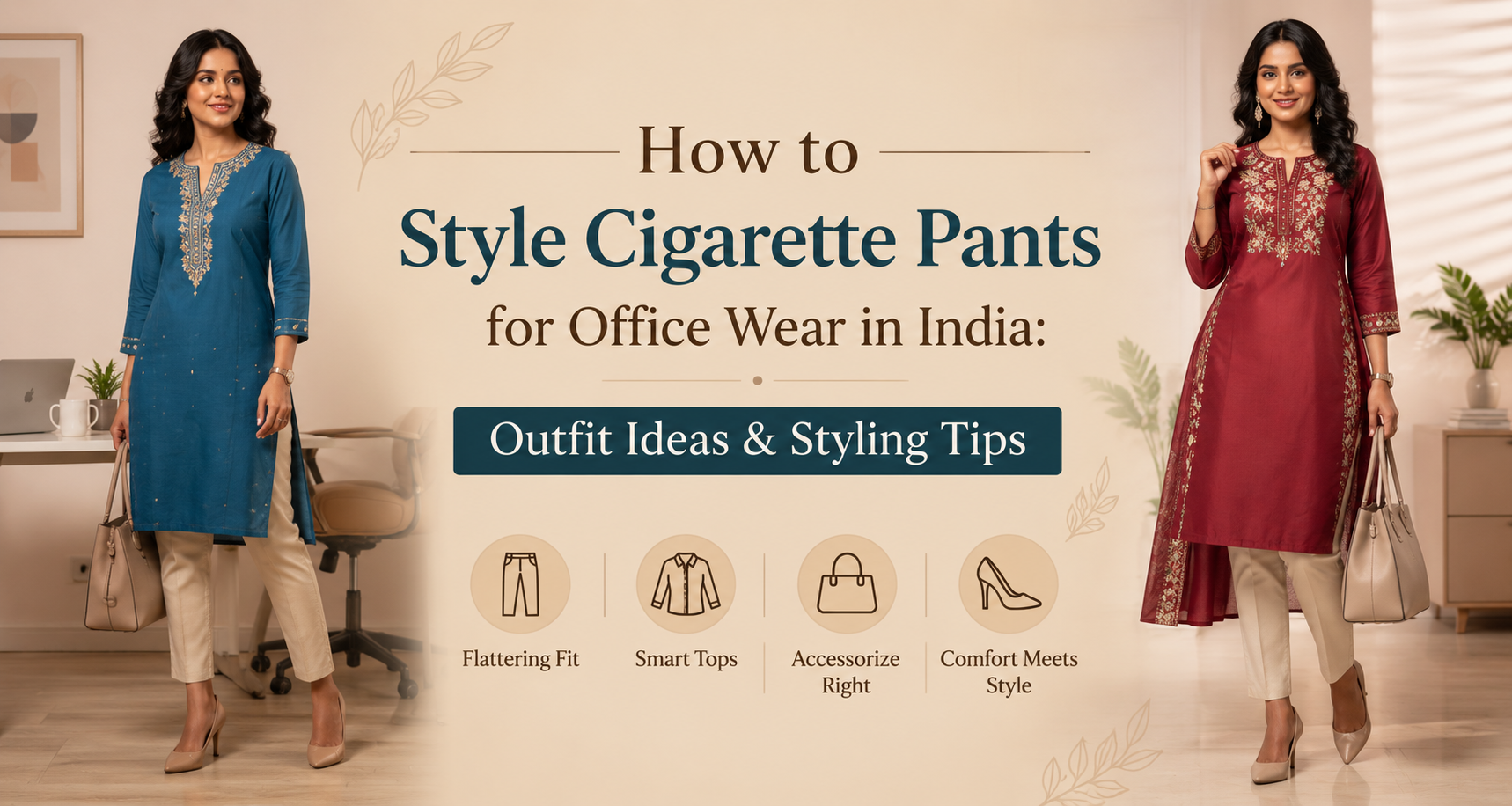
Office wear: A block print kurta set in indigo or earthy tones with cigarette pants and simple silver earrings is one of the most composed looks in ethnic Indian wear for women.
College wear: Lighter cotton block prints with jeans or palazzos and kolhapuris have been popular in colleges across Rajasthan and Gujarat for years.
Festivals and family gatherings: Deep madder red, indigo blue, and earthy rust are popular block print colours for Diwali and Navratri.
Travel: Block print cotton kurtas are genuinely good travel clothes. Lightweight, comfortable in heat, and looks good in photographs.
Casual daily styling: Lighter pastels and softer-toned prints work well when you want to look ethnic every day without putting in too much effort.
Also read: How to Style Cigarette Pants for Office Wear in India
How to Style Block Print Kurtas
1. Bottom Wear Ideas
Ethnic kurtas for women in block prints work best with solid-colored bottoms that let the print stand out.
- Cigarette pants look best for office and semi-formal styling
- Straight cotton trousers are comfortable and very easy for daily wear
- Palazzos give a relaxed feel for casual days or travel
- Churidars pair classically with longer block print or Anarkali styles
- Jeans are good for a casual look with shorter block print tops and tunics for women
- Bottom pants for women in solid black or white are the most versatile base you can build on
Liva Kurtis in softer drape fabrics pair well with slim bottom pants for women for a comfortable daily look that still feels awesome.
A cotton co-ord set for women in a complementary block print fabric is a strong option for festive days when you want a complete ethnic look without too much effort in mixing and matching.
2. Accessories
The handmade nature of block print kurtas pairs best with jewelry that also has craft in it.
- Oxidised silver jhumkas and simple silver bangles work very naturally with block prints
- Kolhapuri flats are the most natural pairing for block print cotton kurtas
- Juttis work well for a more traditional or festive look
- Potli bags suit family functions and festivals
- An embroidered kurta set with a dupatta in a contrasting solid colour or a complementary print rounds the look off properly
Final Thoughts
Now, if you are confused, let us tell you that both types of kurtas have a place in your wardrobe. For everyday office and college wear, printed kurtas give you variety and value.
But if you are buying a Juniper kurta or any block print piece for its craft, its story, and its long life, a hand block print kurta is worth every rupee you spend on it.
FAQs: Block Print Kurtas vs Printed Kurtas
1. What is the difference between a block print kurta and a printed kurta?
Hand block print kurtas are made by artisans in Rajasthan, one wooden block at a time. Printed kurtas come out of machines. Price, feel, and finish are all different between the two.
2. How do I identify if a block print kurta is genuine?
Turn the fabric over. On a real block print kurta, dye comes through to the back side. The motif repeat also looks a little uneven each time. A machine print never has that unevenness.
3. Are block print kurtas good for office wear?
Good option, yes. An indigo or earthy-toned block print kurta set with plain cigarette pants and small earrings gives a very decent ethnic look for office-going women.
4. Which fabric is best for block print kurtas?
Cotton is one of the best fabrics for block print kurtas. Mulmul cotton is even better because it stays cool and gets softer with washing. Chanderi block print kurta sets are good for festivals and formal family occasions.
5. Can block print kurtas be worn for weddings and festive occasions?
Yes, they can. Deep rust, madder red, or indigo block print kurtas with an embroidered kurta set with dupatta are a solid choice for Diwali, Navratri, or any family wedding function.